
Stigmatisch
Optik
© 2026
Definition
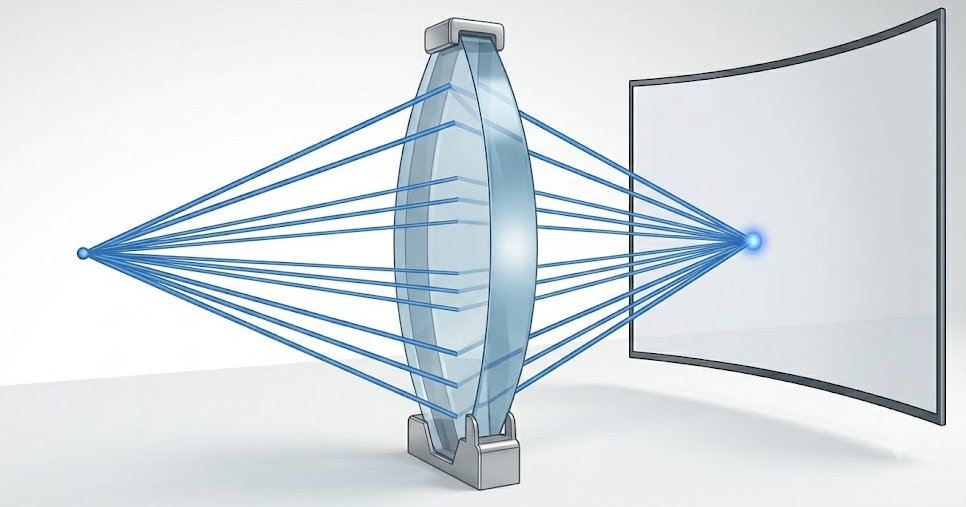
Man nennt ein optisches System, zum Beispiel eine Sammellinse, stigmatisch, wenn jeder Punkt eines Gegenstandes von dem System auf genau einem Bildpunkt abgebildet wird [1] [8], also eine Punkt-zu-Punkt Abbildung [2] erreicht wird. So verbundene Punkte nennt man konjugiert. [7]
Strahlenoptisch
Stellt man sich Licht im Sinne der Strahlenoptik vor, dann dürfe an einem beliebigen Punkt auf der Bildfläche nur Strahlen von genau einem Punkt eines Objektes ankommen.
Lochkamera
Im Falle einer idealisierten Lochkamera ist das Loch so klein, dass nur genau ein Strahl von der Breite her durchgehen kann. Dann kommt auf jedem Punkt des Bildes auch nur genau ein Strahl vom entsprechenden (konjugierten) Punkt des Objektes an.
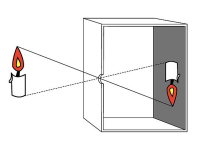
Eine idealisierte Lochkamera mit perfekt kleinem Loch erzeugt in der Strahlenoptik gedacht immer eine stigmatische Abbildung. Siehe auch 👉 Lochkamera
In der Wirklichkeit hätte aber jedes Loch eine echte Breite und es würde mehrere Strahlen von einem Punkt des Objektes durchlassen. Doch wenn das Loch nur klein genug ist, sind diese Strahlen so eng benachbart und fast zueinander parallel,dass sie auf der Bildfläche für alle praktischen Zwecke so eng beieinander ankommen, dass man zumindest näherungsweise noch von einer stigmatischen Abbildung sprechen kann. Sinngemäß gelten diese Überlegung auch für die Lochaugen, wie sie der im Meer lebende Nautilus hat.
Linsenkamera
Bei einer Linsenkamera ist es die Aufgabe der Linse, auf jedem Punkt der Bildfläche nur solche Strahlen ankommen zu lassen, die ursprünglich von einem Punkt des Objektes der Außenwelt ausgingen. Da eine Linse eine größere Ausdehnung hat, muss sie also die von einem Objektpunkt auseinanderlaufenden (divergierenden) Strahlen so umlenken, dass sie nach dem Durchgang durch die Linse wieder zusammenlaufen (konvergieren), um sich letzten Endes in einem Bildpunkt zu treffen.
Eine Linsenkamera fängt das Licht aus einem größeren Bereich ein. Dafür muss sie aber auch dafür sorgen, dass von einem Objektpunkt aus kommende Strahlen auch auf einen Punkt im Bild zugeführt werden.
Reale Linsen können für ausgedehnte Objekte niemals perfekt stigmatisch sein. [3] Ist eine Abbildung für Punkte auf der optischen Achse stigmatisch gilt die Herschel-Bedingung. [4] Werden auch achsennahe und senkrecht zur optischen Achse angeordnete Bildpunkte fehlerfrei (stigmatisch) abgebildet wird auch die (Abbesche) Sinusbedingung erfüllt. [5] In der Regel ist es nicht möglich, beide Bedingungen gleichzeitig zu erfüllen. [6]
Die Gründe sind aber nicht in der Strahlenoptik zu suchen. Erst wenn man Licht mit Welleneigenschaften denkt, versteht man, warum reale Linsen immer etwas von einer perfekt stigmatischen Abbildung abweichen. Siehe dazu den Artikel zur 👉 Aberration
Fußnoten
- [1] Zur Definition: "a system is defined to be stigmatic if and only if, through the system, every point object maps to a point image." In: Harris WF. Stigmatic optical systems. Optom Vis Sci. 2004 Dec;81(12):947-52. PMID: 15592120. Online: https://pubmed.ncbi.nlm.nih.gov/15592120/
- [2] "Stigmatic Imaging: A point-to-point imaging condition. No aberrations. In a stigmatic system, all possible optical paths have the same time of travel, or same optical path length. The optical path length of all rays between two points in a stigmatic system are identical. An optical system that is stigmatic produces only spherical and plane wavefronts from spherical or plane wavefronts." In: Raymond C. Rumpf: Geometric Optics Definitions. EMP Possible, 2024. Online: https://empossible.net/wp-content/uploads/2024/06/EMP-Geometric-Optics-Definitions.pdf
- [3] Wellenoptik als Problem: "stigmatisch, punktförmig, Bezeichnung für die Abbildung von Bildpunkten durch homozentrische Strahlenbündel in der geometrischen Optik. Wellenoptisch verhindert die Beugung eine stigmatische Abbildung." In: Spektrum Lexikon der Optik. Dort der Artikel "stigmatisch". Abgerufen am 1. April 2026. Online: https://www.spektrum.de/lexikon/optik/stigmatisch/3219
- [4] "The Herschel’s condition states that for a system which is stigmatic for two conjugate axial points, will also be free of spherical aberration for two neighbouring and conjugate points on the optical axis." In: Rafael G. González-Acuña, Julio C. Gutiérrez-Vega: Exact equations to design a stigmatic singlet that meets the Herschel’s condition. Optics Communications. Volume 485, 15 April 2021, 126727. Zur historischen Formulierung siehe auch: John Frederick William Herschel: XVII. On the aberrations of compound lenses and object-glasses. Philosophical Transactions of the Royal Society. 111: 222–267. Veröffentlich im Jahr 1823. doi:10.1098/rstl.1821.0018
- [5] Zur (abbeschen) Sinusbedingung: Spektrum Lexikon der Optik. Dort der Artikel "Abbesche Sinusbedingung". Heidelberg: Spektrum Akademischer Verlag, 1999. Online: https://www.spektrum.de/lexikon/optik/abbesche-sinusbedingung/11.
- [6] "Sowohl die Sinusbedingung, die die scharfe Abbildung eines kleinen Flächenstücks um den Gaußschen Fokuspunkt gewährleistet, als auch die Herschel-Bedingung, die für die scharfe Abbildung eines kleinen Segments entlang der optische Achse um den Fokuspunkt erfüllt sein muss, folgen in der geometrisch-optischen Theorie aus der Punkt-Charakteristik des optischen Systems. Wegen der verschiedenen Abhängigkeit vom Öffnungswinkel können aber beide Bedingungen im Allgemeinen nicht gleichzeitig erfüllt sein". In: Norbert Kerwien: Zum Einfluss von Polarisationseffekten in der mikroskopischen Bildentstehung. Dissertation. Institut für Technische Optik der Universität Stuttgart. 2007. ISBN 978-3-923560-57-8Dort im Kapitel "5.2 Die perfekte Abbildung". Online: file:///home/wh54/Downloads/Diss_Kerwien_online.pdf
- [7] Von konjugierten Punkten und stigmatischen Systemen spricht man, wenn Strahlen von einem Punkt eindeutig durch einen zweiten Punkt gehen: "if rays leaving a point [from the object space] arrive at another point [image space], the optical system is called stigmatic for these two points [...] are called conjugate points." In: Marc Levoy: Optics I: lenses and apertures. CS 178, Spring 2009. Computer Science Department. Stanford University. Online: https://graphics.stanford.edu/courses/cs178-09/lectures/optics1-07apr09.pdf