
Luddismus
Geschichte
© 2016
- 2026
Grundidee
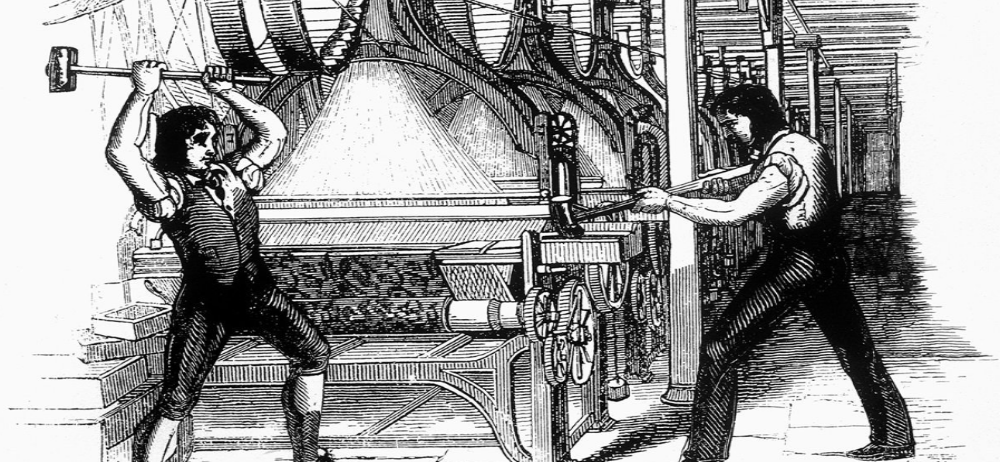
Der Luddismus war eine Bewegung englischer Arbeiter und Handwerker aus der Zeit von etwa 1811 (Napoleon) bis zur gewaltsamen Niederschlagung im Jahr 1814. Die Luddisten benannten sich nach ihrem fiktiven Anführer Ned Ludd. Der Zorn speiste sich aus unwürdigen Lebensverhältnissen [1] [2] und richtete sich oft gegen den sichtbaren Einsatz von Maschinen, die den eigenen Lebensunterhalt gefährdeten. Es kam zu regelrechten Schlachten zwischen Luddisten und der Staatsgewalt. Am Ende setzte sich die Staatsmacht Englands durch. Die „Maschinenstürmerei“ galt als Kapitalverbrechen, viele Luddisten wurden als Sträflinge nach Australien deportiert oder hingerichtet. Auf die Tradition dieser frühen Maschinenstürmer beruft sich die Bewegung des Neo-Luddismus aus dem 21. Jahrhundert.
Gesetzgebung
Im Jahr 1812 wurde in England ein auf zwei Jahre befristetes Gesetz verabschiedet, dass die Maschinenstürmerei in der Zeit des Luddismus zu einem Kapitalverbrechen machte. Das heißt dass die Hinrichtung als Höchststrafe möglich wurde. Der originale englischsprachige Text aus dem Jahr 1812 ist umschweifig verfasst aber sehr interessant zu lesen. Zunächst wird die ungenügende Wirksamkeit der bisherige Gesetzgebung beklagt:
ZITAT:
"WHEREAS the Provisions of an Act of the Twenty eighth Year of the Reign of His present Majesty, intituled An Act for the better and more effectual Protection of Stocking Frames and the Machines or Engines annexed thereto or used therewith, and for the Punishment of Persons destroying or injuring of such Stocking Frames, Machines or Engines, and the Framework knitted Pieces, Stockings, and other Articles and Goods used and made in the Hosiery or Framework knitted Manufactory, or breaking or destroying any Machinery contained in any Mill or Mills used or in any way employed in preparing or Spinning of Wool or Cotton for the Use of the Stocking Frame, have been found ineffectual"
"WHEREAS the Provisions of an Act of the Twenty eighth Year of the Reign of His present Majesty, intituled An Act for the better and more effectual Protection of Stocking Frames and the Machines or Engines annexed thereto or used therewith, and for the Punishment of Persons destroying or injuring of such Stocking Frames, Machines or Engines, and the Framework knitted Pieces, Stockings, and other Articles and Goods used and made in the Hosiery or Framework knitted Manufactory, or breaking or destroying any Machinery contained in any Mill or Mills used or in any way employed in preparing or Spinning of Wool or Cotton for the Use of the Stocking Frame, have been found ineffectual"
Da die Auswüchse (outrages) der Maschinenstürmer anhalten, wird eine Verschärfung nötig. Bemerkenswert in dem originalen Gesetzestxt von 1812 ist, wie eng und genau die eigentliche Straftat definiert wird. Die Beschreibung dessen, was genau verboten sein soll, nimmt den größten Teil der nächsten Textstelle ein. Das Strafmaß wird erst am Ende und dann nur kurz beschrieben:
ZITAT:
"And whereas such Outrages have for some time past been carried on to an alarming Extent; it is therefore necessary that more effectual Provisions should be made against such unlawful Practices, and for preventing such Outrages, and bringing Offenders therein to exemplary Justice; and that such Provisions should be extended to the Frame-work Lace Manufactory, against which similar Outrages have been committed: May it therefore please Your Majesty that it may be enacted; and be it enacted by the King's Most Excellent Majesty, by and with the Advice and Consent of the Lords Spiritual and Temporal, and Commons, in this present Parliament assembled, and by the Authority of the same, That if any Person or Persons shall, by Day or by Night, enter by Force into any House, Shop or Place, with an Intent to cut or destroy any Framework knitted Pieces, Stockings or Lace, or other Articles or Goods being in the Frame, or upon any Machine or Engine thereto annexed, or therewith to be used or prepared for that Purpose; or with an Intent to break or destroy any Frame, Machine, Engine, Tool, Instrument or Utensil, used in and for the working and making of any such Framework knitted Pieces, Stockings, Lace, or other Articles or Goods in the Hosiery or Framework knitted Manufactory; or shall wilfully and maliciously, and without having the Consent or Authority of the Owner, destroy, or cut with an Intent to destroy or render useless, any Framework knitted Pieces, Stockings, Lace, or other Articles or Goods being in the Frame, or upon any Machine or Engine as aforesaid, or prepared for that Purpose; or shall wilfully and maliciously, and without having the Consent or Authority of the Owner, break, destroy or damage with an Intent to destroy or render useless any Frame, Machine, Engine, Tool, Instrument or Utensil used in and for the working and making of any such Framework knitted Pieces, Stockings, Lace, or other Articles or Goods in the Hosiery or Framework knitted Stocking, or Framework Lace Manufactory; or shall wilfully and maliciously, and without having the Consent or Authority of the Owner, break or destroy any Machinery contained in any Mill or Mills used or any way employed in preparing or spinning of Wool or Cotton, or other Materials for the Use of the Stocking or Lace Manufactory, every Offender being thereof lawfully convicted shall be adjudged guilty of Felony, and shall suffer Death, as in cases of Felony without Benefit of Clergy."
"And whereas such Outrages have for some time past been carried on to an alarming Extent; it is therefore necessary that more effectual Provisions should be made against such unlawful Practices, and for preventing such Outrages, and bringing Offenders therein to exemplary Justice; and that such Provisions should be extended to the Frame-work Lace Manufactory, against which similar Outrages have been committed: May it therefore please Your Majesty that it may be enacted; and be it enacted by the King's Most Excellent Majesty, by and with the Advice and Consent of the Lords Spiritual and Temporal, and Commons, in this present Parliament assembled, and by the Authority of the same, That if any Person or Persons shall, by Day or by Night, enter by Force into any House, Shop or Place, with an Intent to cut or destroy any Framework knitted Pieces, Stockings or Lace, or other Articles or Goods being in the Frame, or upon any Machine or Engine thereto annexed, or therewith to be used or prepared for that Purpose; or with an Intent to break or destroy any Frame, Machine, Engine, Tool, Instrument or Utensil, used in and for the working and making of any such Framework knitted Pieces, Stockings, Lace, or other Articles or Goods in the Hosiery or Framework knitted Manufactory; or shall wilfully and maliciously, and without having the Consent or Authority of the Owner, destroy, or cut with an Intent to destroy or render useless, any Framework knitted Pieces, Stockings, Lace, or other Articles or Goods being in the Frame, or upon any Machine or Engine as aforesaid, or prepared for that Purpose; or shall wilfully and maliciously, and without having the Consent or Authority of the Owner, break, destroy or damage with an Intent to destroy or render useless any Frame, Machine, Engine, Tool, Instrument or Utensil used in and for the working and making of any such Framework knitted Pieces, Stockings, Lace, or other Articles or Goods in the Hosiery or Framework knitted Stocking, or Framework Lace Manufactory; or shall wilfully and maliciously, and without having the Consent or Authority of the Owner, break or destroy any Machinery contained in any Mill or Mills used or any way employed in preparing or spinning of Wool or Cotton, or other Materials for the Use of the Stocking or Lace Manufactory, every Offender being thereof lawfully convicted shall be adjudged guilty of Felony, and shall suffer Death, as in cases of Felony without Benefit of Clergy."
In der letzten Zeile also wird die Todesstrafe erwähnt. Was aber bedeutet "Felony without Benefit of Clergy"? Das Wort felony steht im Englischen für ein schwereres Verbrechen, in Abgrenzung zu einem bloßen Vergehen (misdemenour). Wirklich interessant ist die Instiution der Benefit of Clergy, auf Deutsch das Privileg der Geistlichkeit. Wer als Angeklagter seine Zugehörigkeit zur Kirche nachweisen konnte, konnte sich unter ein Kirchengericht stellen. Diese urteilten oft milder als weltliche Gerichte. Zur Zeit der Ludditen wurde die Benefit of Clergy oft auf alle Ersttäter ausgedehnt. Oft aber schloss die Gesetzgebung dieses Schlupfloch auf dem Weg zu einer härten Bestrafung ausdrücklich aus.
Das nun folgende, sehr lange Zitat, stellt auch die Mitwisserschaft unter Strafe, wenn die Zeugen einer Maschinenstürmerei diese nicht zu Anzeige bringen. Man könnte kritisch auch von einem Aufruf zum Denunziantentum sprechen:
ZITAT:
"And be it further enacted, That every Person in whose House or Custody or Possession any Frame, Machine or Engine, Tool, Instrument or Utensil, used in and for the working and making of any Framework knitted Pieces, Stockings, Lace, or other Articles or Goods in the Hosiery or Framework knitted Stocking, or Framework Lace Manufactory as aforesaid (not being his or her Property) shall be at the time of the Destruction or damaging thereof, or of any Framework knitted Pieces, Stockings, Lace, or other Articles or Goods, being in the Frame, or upon any Machine or Engine as aforesaid, and who shall not, within Twenty four Hours after he or she shall have known of such Destruction or Damage being committed as aforesaid, give Notice thereof to the Owner of such Frame, Machine or Engine, Tool, Instrument or Utensil, as aforesaid, if residing within Twelve Miles, or if such Owner shall not reside within such Distance, then to some known Agent of such Owner, if any such Agent shall reside within the Distance of Twelve Miles; and also within Forty eight Hours, go before some Justice of the Peace or Magistrate residing near the Place where such Destruction or Damage shall have taken place as aforesaid, to be examined upon Oath, as to every Matter or Thing relating to the committing of such Destruction and Damage, and his Knowledge thereof, and of all Particulars relating thereto, which may lead to the Discovery of the Offender therein, every such Person shall for every such Neglect, be deemed guilty of a Misdemeanor; and every such Offender, being thereof lawfully convicted upon any Indictment or Information, may be punished as in Cases of Misdemeanor, by Fine and Imprisonment, at the Discretion of the Court in which he shall be convicted; and every Justice of the Peace or Magistrate before whom any such Person shall so go, shall examine such Person upon Oath (which Oath every such Justice of the Peace or Magistrate is hereby authorized to administer) as to his Knowledge of such Damage or Destruction, and of the Persons committing the same, or of any Particulars which may lead to the Detection of the Offenders therein; and shall also allow the Owner of the Frame, Machine or Engine, Tool, Instrument or Utensil, as aforesaid, or Agent if present, to put any Question upon Oath to such Person for the Discovery of the Offender; and if such Owner or Agent shall not have had sufficient Notice to be present when such Person came before the Justice or Magistrate for Examination as aforesaid, such Justice of the Peace or Magistrate shall, if required by the Owner or Agent aforesaid, or if such Justice of the Peace or Magistrate shall deem it necessary, although no such Requisition shall be made, again call such Person before him for Examination by the Owner or Agent aforesaid; and every such Person who shall neglect or refuse (upon being summoned) to appear again before such Justice of the Peace or Magistrate, and be again examined as aforesaid, shall be deemed guilty of a Misdemeanor, and punished as in cafes of Misdemeanors, at the Discretion of the Court in which he or she shall be convicted."
"And be it further enacted, That every Person in whose House or Custody or Possession any Frame, Machine or Engine, Tool, Instrument or Utensil, used in and for the working and making of any Framework knitted Pieces, Stockings, Lace, or other Articles or Goods in the Hosiery or Framework knitted Stocking, or Framework Lace Manufactory as aforesaid (not being his or her Property) shall be at the time of the Destruction or damaging thereof, or of any Framework knitted Pieces, Stockings, Lace, or other Articles or Goods, being in the Frame, or upon any Machine or Engine as aforesaid, and who shall not, within Twenty four Hours after he or she shall have known of such Destruction or Damage being committed as aforesaid, give Notice thereof to the Owner of such Frame, Machine or Engine, Tool, Instrument or Utensil, as aforesaid, if residing within Twelve Miles, or if such Owner shall not reside within such Distance, then to some known Agent of such Owner, if any such Agent shall reside within the Distance of Twelve Miles; and also within Forty eight Hours, go before some Justice of the Peace or Magistrate residing near the Place where such Destruction or Damage shall have taken place as aforesaid, to be examined upon Oath, as to every Matter or Thing relating to the committing of such Destruction and Damage, and his Knowledge thereof, and of all Particulars relating thereto, which may lead to the Discovery of the Offender therein, every such Person shall for every such Neglect, be deemed guilty of a Misdemeanor; and every such Offender, being thereof lawfully convicted upon any Indictment or Information, may be punished as in Cases of Misdemeanor, by Fine and Imprisonment, at the Discretion of the Court in which he shall be convicted; and every Justice of the Peace or Magistrate before whom any such Person shall so go, shall examine such Person upon Oath (which Oath every such Justice of the Peace or Magistrate is hereby authorized to administer) as to his Knowledge of such Damage or Destruction, and of the Persons committing the same, or of any Particulars which may lead to the Detection of the Offenders therein; and shall also allow the Owner of the Frame, Machine or Engine, Tool, Instrument or Utensil, as aforesaid, or Agent if present, to put any Question upon Oath to such Person for the Discovery of the Offender; and if such Owner or Agent shall not have had sufficient Notice to be present when such Person came before the Justice or Magistrate for Examination as aforesaid, such Justice of the Peace or Magistrate shall, if required by the Owner or Agent aforesaid, or if such Justice of the Peace or Magistrate shall deem it necessary, although no such Requisition shall be made, again call such Person before him for Examination by the Owner or Agent aforesaid; and every such Person who shall neglect or refuse (upon being summoned) to appear again before such Justice of the Peace or Magistrate, and be again examined as aforesaid, shall be deemed guilty of a Misdemeanor, and punished as in cafes of Misdemeanors, at the Discretion of the Court in which he or she shall be convicted."
Persönliche Anmerkung
 Die Todesstrafe für die Zerstörung eines Webstuhls in einer Fabrik: das erscheint uns heute als überzogen. Die Frage ist dann aber, wie unsere modernen Industriegesellschaften ihre Produktionsmittel vor einer Zerstörung durch Unzufriedene schützen. Ein Blick auf die Geschichte der Klimaaktivisten in den frühen 2020er Jahren zeigt, dass di Obrigkeit abschreckende Strafen noch immer einem schwer kontrollierbaren öffentlichen Dialog vorzieht. Auf sehr viel tiefgehender Innovationen im Instrumentarium der Herrschaft aber verweisen die Ideen der Kritischen Theorie, einer soziologischen Strömung aus der Zeit von etwa 1945 bis 1970 ab. Demnach ist es den Herrschenden gelungen, dass sich die ehemals Benachteiligten als selbtverantwortliche Teilhaber am gesamten System sehen. Und dem französischen Soziologen Chamayoux zufolge gelang es den Herrschenden, die Verantwortung für alles Wohl oder Übel ganz auf die Einzelpersonen zurück zu verlagern. Wer heute etwa seinen Arbeitsplatz durch KI bedroht sieht hätte als Reflex nicht mehr den Drang, Rechenzentren zu zerstören, sondern sich selbst fortzubilden oder einen anderen Job zu suchen. Wer den Klimawandel beklagt zeigt nicht auf die Profiteure aus der fossilen Industrie sondern bemüht sich in seinem kleinen Kreis etwas zu bewirken. Doch damals wie heute: auf beide Weisen überlässt man das Ruder dem Großen Geld. Ein tieferer Blick in die (gut dokumentierte) Geschichte des Luddismus aus England im frühen 19. Jahrhundert zeigt also viele lehrreiche Parallelen zu aktuellen Problemen, aber gleichzeitig auch eine gänzlich geänderte Realität gesellschaftlicher Reaktionen darauf.
Fußnoten
- [1] Der im 18ten Jahrhundert in England zunehmende Reichtum verteilte sich nicht gleichmäßig auf die Bevölkerung. Insbesondere die Ärmsten (die "labouring poor) lebten weiter in erbärmlichen Verhältnissen: täglich bis zu 16 Stunden Arbeit, sechst Tage die Woche mit nur zwei freien Tagen an Weihnachten und Osterstonntag, bis zur völligen Erschöpfung (the human animal broke down under the burden) und mit Ausschweifungen (drink, lechery, blood-sports) als einziger Ablenkung. Gewaltsame Ausbrüche, wie die Aufstände der Ludditen, blieben dabei eine politisch eher wirkungslose Wutbekundung (pointless, frenzied industrial jacquerie). In: J. H. Plumb: England in the Eighteenth Century (1715-1815). The Pelican History of England. Penguin Books. Erstausgabe 1950. Dort das Kapitel "The Agrarian and Industrial Revolution". In der Ausgabe von 1965 steht die maßgebliche Stelle auf Seite 150.
- [2] Sir Frederic Morten: The state of the poor; or, an history of the labouring classes in England, from the conquests to the present period. In which are particularly considered, their domestic economy, with respect to diet, dress, fuel, and habitation; and the various plans which, from time to time, have been proposed, and adopted, for the relief of the poor: together with parochial reports relative to the administration of work-houses, and houses of industry; the state of friendly societies; and other public institutions ... / With a large appendix containing a comparative and chronological table of the prices of labour, of provisions, and of other commodities ... an account of the poor in Scotland, etc. 1797.
- [2] Gavin Mueller: Maschinenstürmer. Autonomie und Sabotage; Edition Nautilus, Hamburg 2022, 232 Seiten. Ins Deutsche übersetzt vom Englischen Original "Breaking Things at Work: The Luddites Are Right About Why You Hate Your Job" von Josefine Haubold. ISBN: 978-3-96054-307-7. Siehe auch 👉 Neo-Luddismus